Before “psychedelic rock” was a bin card in record stores, it was a word Tommy Hall borrowed from Timothy Leary’s writings and applied to a brand-new Austin band. The 13th Floor Elevators formed in 1965 around Hall’s lyrics and electric jug, Stacy Sutherland’s lead guitar, a rhythm section drawn from the coastal Texas group the Lingsmen, and Roger Kynard “Roky” Erickson — still a teenager — who left the Spades to sing and play rhythm guitar. Within a year they had a national single, a provocatively titled debut album, and the attention of both San Francisco ballroom bookers and Texas law enforcement.
What made them unmistakable was not only Erickson’s shredded, gospel-fierce voice. It was the jug: a clay whiskey vessel that Hall treated as an amplifier for the human voice rather than as a folk bass substitute. For a deeper portrait of Erickson after the Elevators, see Roky Erickson & the 13th Floor Elevators and the documentary guide You’re Gonna Miss Me.
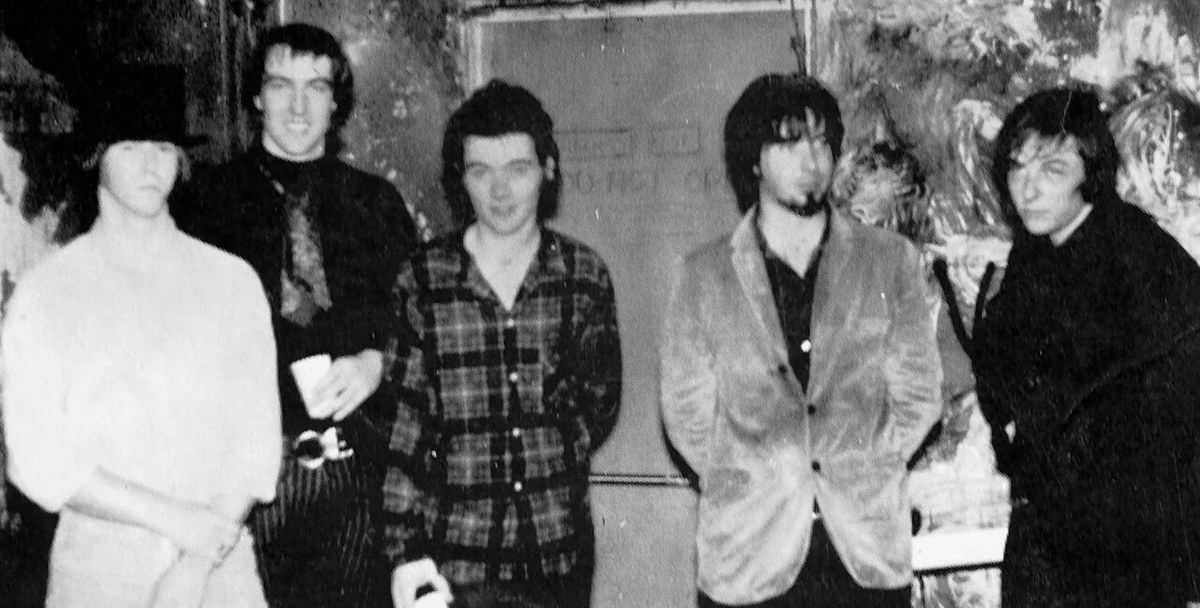
Naming a sound — and a band
Hall was a University of Texas student working through philosophy, psychology, and chemical engineering when he began assembling the group. Clementine Hall reportedly suggested the name 13th Floor Elevators: American high-rises often skip a labeled thirteenth floor, so the phrase implied travel to another level of consciousness. Others have linked the “thirteenth” to the letter M and marijuana. In November 1965 Hall began describing the band’s sound as psychedelic — garage rock braided with folk, R&B, and lyrics shaped by hallucinogenic experience — and Erickson’s screaming lead vocals finished the argument.
Why the jug sounded like nothing else
Traditional jug-band players blow across the opening to produce a low, tuba-like thump. Hall did something else. He vocalized melodic runs into the mouth of the jug, using the clay chamber for resonance, echo, and distortion. Live, he held a microphone to the jug’s opening; when recording Easter Everywhere, engineers reportedly placed a microphone inside the jug to exaggerate the effect. The result sat somewhere between a cuíca, an early synthesizer, and a human voice trapped in pottery — a signature that no cover band could fake with a guitar pedal alone.
Hall was frank, in later interviews, about why he invented it. He did not consider himself a conventional musician. He wanted a place onstage so he could deliver lyrics shaped by study and LSD experience. The jug was a tool of presence as much as of timbre: a way for the band’s resident theorist to stand inside the music instead of only writing it.
From Contact Records to International Artists
Erickson’s earlier band, the Spades, had already cut “You’re Gonna Miss Me” for Austin’s Zero Records. The Elevators re-recorded it harder, closer to the Kinks and Stones energy they admired, and issued it with “Tried to Hide” on the small Contact label. Regional television followed — including Dallas’s Sump’n Else and Houston’s Larry Kane Show. Houston’s International Artists soon signed the group, hired Lelan Rogers (brother of Kenny Rogers) for promotion and production, and re-released the single nationally in mid-1966. It became the band’s biggest commercial moment, reaching the mid-50s on the Billboard charts (Handbook of Texas cites number 56).
The debut LP, The Psychedelic Sounds of the 13th Floor Elevators (November 1966), announced the aesthetic in its title. The follow-up, Easter Everywhere (1967), is often cited by fans and historians as a high-water mark of American psychedelia — denser, more exploratory, still anchored by Erickson’s voice and Hall’s jug. A 1968 “live” album padded with studio outtakes and dubbed applause disappointed commercially. Bull of the Woods (January 1969) leaned on Sutherland’s writing and was finished without Erickson’s full participation as the singer’s legal and medical crises consumed the band.
West Coast heat, Texas heat
Success pulled the Elevators to San Francisco ballrooms — the Fillmore Auditorium, the Avalon Ballroom — and onto national television (American Bandstand, Where the Action Is). They shared bills with acts such as the Grateful Dead, Moby Grape, and Big Brother and the Holding Company. Bassist Benny Thurman stayed in Texas; Ronnie Leatherman stepped in. Back home, open drug advocacy and marijuana arrests brought Texas Rangers and radio bans. In one 1966 case, charges against Walton and Erickson were dropped on a technicality while Sutherland and Hall received suspended sentences. Public pressure later eased some radio blacklists, but the pattern was set: the band’s philosophy made them a law-enforcement target in a state that did not romanticize the counterculture.
Lineup churn followed. In summer 1967 Walton and Leatherman left; Danny Thomas (drums/piano) and Dan Galindo (bass) arrived. Touring contracted toward Texas as legal and personal problems mounted. Erickson’s 1969 marijuana arrest — not his first — led him to choose commitment at Rusk State Hospital for the Criminally Insane over a long prison term. The Elevators effectively ended there. Hall eventually returned to San Francisco; most other members stayed in Texas. Sutherland was fatally shot by his wife in 1978. Surviving members reconvened in fragments over the decades, including a May 10, 2015 Levitation (Austin Psych Fest) anniversary set with Erickson, Hall, Walton, and Leatherman.
What the Elevators left behind
Influence lists are easy to inflate, but the Elevators’ documented admirers and legatees are real: Texas punk and neo-psych scenes, artists who covered Erickson on the 1990 Sire tribute Where the Pyramid Meets the Eye, and later musicians from Robert Plant to the White Stripes who publicly acknowledged the debt. International Artists’ 2009 box set Sign of the 3 Eyed Men and Paul Drummond’s biography Eye Mind gave historians a denser archive. The electric jug remains the easiest shorthand for their difference — a reminder that psychedelia was not only fuzz pedals and sitars. Sometimes it was a philosophy student singing into a jug so the words would leave the room changed.
Related: Roky Erickson & the 13th Floor Elevators · You’re Gonna Miss Me
Leave a Reply